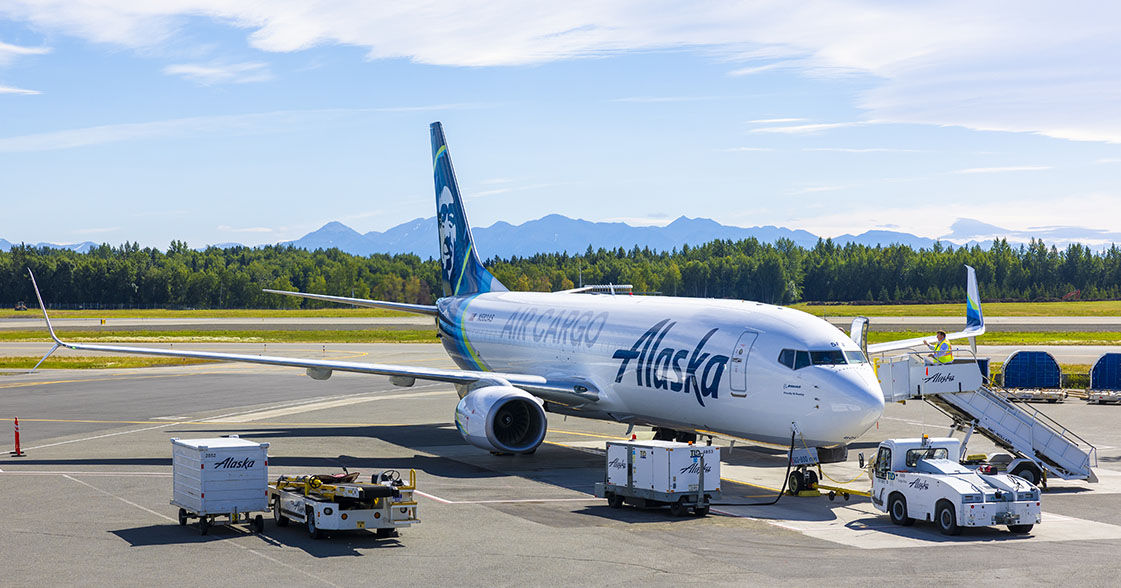
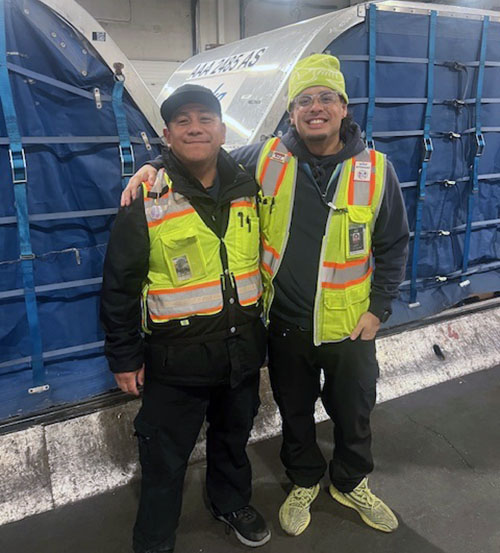
 Leo and Benjamin at the Alaska Air Cargo station in Anchorage.TEAM SPOTLIGHT:
- Benjamin, designated trainer, ramp: Veteran of the Army Reserves, 6 years, and the Alaska Army National Guard, 3 years. Key member of Alaska Airlines and Alaska Air Cargo teams since 2019.
- Leo, lead ramp agent: Veteran of the Army Reserves, 9 years. Key member of Alaska Air Cargo team since 2006.
- Mario, customer service agent: Veteran of the Alaska Army National Guard, 20 years. Key member of Alaska Airlines and Alaska Air Cargo teams since 2021.
STATION SPOTLIGHT: Anchorage (ANC)
Alaska Air Cargo has dozens of flights every day connecting the state’s largest city with 18 remote communities across the state, along with destinations in the lower 48 and Hawai‘i. Anchorage is also a vital hub for our dedicated freighters, which carry everything from heavy equipment to groceries, medicines and household goods to the communities we serve. In 2027, Anchorage’s network will expand to include seasonal nonstop service to Tokyo Narita (NRT), as well as Austin (AUS), Dallas (DFW) and Nashville (BNA).
At Alaska Air Cargo’s bustling Anchorage station, customers will find Benjamin, Leo and Mario doing everything from accepting shipments to explaining regulations to loading up freighters. In every task, their commitment to a smooth operation is a constant anchor for the team — rooted in their shared experience of service to our country.
Between them, they have more than three decades of service in the Army Reserves and Alaska Army National Guard, with experiences ranging from training soldiers on communications to operating heavy equipment to supporting search and recovery efforts.
This week we celebrate Veterans Day by honoring all those like Leo, Benjamin and Mario whose military service experience makes our teams stronger throughout our Alaska and Hawaiian Airlines global network.
“Our veterans bring a strong sense of service and teamwork to our operation,” said Peter Gundersen, director of cargo operations for the state of Alaska. “They lead by example, share their knowledge and coach and mentor our teams.”
This fall, Leo, Mario and Benjamin took time in between flights to talk about how they draw on their military experience in their work, what they enjoy most about helping Anchorage customers, and what they tell veterans who are new to the civilian workforce.
How did your experience in the military translate to your work now?
Leo: “In the Army Reserves, I was a signal support specialist. My primary role was doing technical work on communications equipment and then teaching operators how to use it. … In my unit, we developed a mental strength dealing with fast-paced, stressful situations. When you work with customers in cargo, it’s kind of the same. You have to think on your feet to help the customers. So, having that mental fortitude really helped.”
Benjamin: “I did a lot of forklift work and logistics, and I was a material handler, so that work all definitely transitioned to cargo. … Coming from the military also helped me in becoming a leader, being a trainer, being patient and working with teams.”
Mario: “At cargo, we have a bunch of different positions, sort of like the military. In the military when you tell people you're in services they think, ‘Oh, you're a cook.’ But we also run the gyms, we run the MWR [Morale, Welfare and Recreation] tents, we run mortuary, we run search and recovery. In cargo, we have load control, we have floor check, we have dangerous goods, we have screeners — many different things that you can learn to do as a CSA [customer service agent]. We had to learn five to seven different tasks in the military, not just be proficient in one, so that helped me in cargo, where I can do almost everything.”
What do you enjoy most about working with customers?
Leo: “In most cargo departments, you'll have two workgroups: You'll have one that works the warehouse — buildups, customer service, etc. Then you'll have one for the ramp, working on the aircraft. Here in Anchorage, we do both the cargo warehousing as well as loading the aircraft. So, you can work with the shipment all the way from acceptance, through helping out the customer, determining how to get it there faster, all the way to screening, building it up for the flight, and then loading it on the aircraft. It feels like you have more impact on the outcome of a customer's experience, which I enjoy.”
Benjamin: “On the passenger side, you see one person and then they're gone. In cargo, you're seeing a lot of the same faces every day.”
Mario: “We get to know a lot of our regulars. You talk about your vacations, you talk about each other's kids, and you see them out in the community. That builds a good rapport. It builds our customer base because customer service goes beyond coming to cargo.”
What’s unique about the shipments that come through Anchorage?
Mario: “We work a lot with the smaller communities around the state. We ship stuff off to places like Barrow (BRW), Juneau (JNU) and Nome (OME), and from there, it goes onto smaller planes to get out to the smaller communities. That's a big difference in Alaska. We have smaller towns that you can't get to by road, so stuff has to fly out, and we know how to help the customers get it there.”
What advice do you give to veterans making the transition to civilian jobs?
Mario: “I tell people, just take it one day at a time. Try to learn as much as you can about that new job if you want to move up in the ranks in seniority. And then reevaluate after six months and see if that's truly a job you want to be at. The first job might not be the right job for you.”
Benjamim: “I tell the new guys, take advantage of any opportunity that presents itself, any training that comes to you, any new policy, anything that you can do better. … It's cool working in aviation because things are changing all the time. Policies are changing all the time. And more destinations open up, so there's more opportunities. ... Now we have Airbuses and the widebodies. There's new training and new aircraft to learn. And it's fun to challenge yourself. It makes you a better worker.”
What do you enjoy about working with the cargo team in Anchorage?
Leo: “Now that I'm getting older, I enjoy training the next generation, seeing them learn. At the same time, a lot of them come in with different views on how things work and out-of-the-box thinking, and it is refreshing to see their take. … The cargo department here is very small, so you get to know everyone, and we really look out for each other.”
Benjamin: “Within the cargo team, they are very appreciative of military personnel, and the camaraderie here among all of us is really, really deep. A lot of guys hang out outside of work. We go fishing with each other. Everybody really takes care of each other. If you're having a bad day, people check up on you. .. It's a really tight-knit group. It’s like a family, and it’s cool to be a part of it.”
About Alaska Air Cargo and Hawaiian Air Cargo
Together, Alaska Air Cargo and Hawaiian Air Cargo reach 110-plus cargo destinations around the world, including cities across Asia, the South Pacific, the Americas and Europe. With more than 90 years of experience carrying vital shipments to remote communities, our air cargo teams share deep connections to the communities where we live, work and fly.
Toys for Tots: Giving Santa a lift in Alaska
For 16 years, the Anchorage warehouse has been the hub for donations to Toys for Tots — our annual partnership with the U.S. Marine Corps Reserve to deliver Christmas joy to children in remote communities across Alaska. Alaska Airlines Captain Tom Sharkey has volunteered with Toys for Tots since his military service days in the early 1990s, and he coordinated the shipments with our cargo teams and the Marine Corps Reserve for many years.
This holiday season our cargo teams expect to ship more than 10,000 pounds of toys to kids across the state. Learn more about Toys for Tots

For updates on new routes and operational changes, subscribe to our email newsletter